archi-intelligence · Research Series
Frameworks
The analytical frameworks established across the AI² Research Series. Each figure is reproduced from its source working paper with full attribution. The papers themselves carry the evidence tiering, evaluation windows, and methodology behind every figure — read them for the reasoning these diagrams summarise.
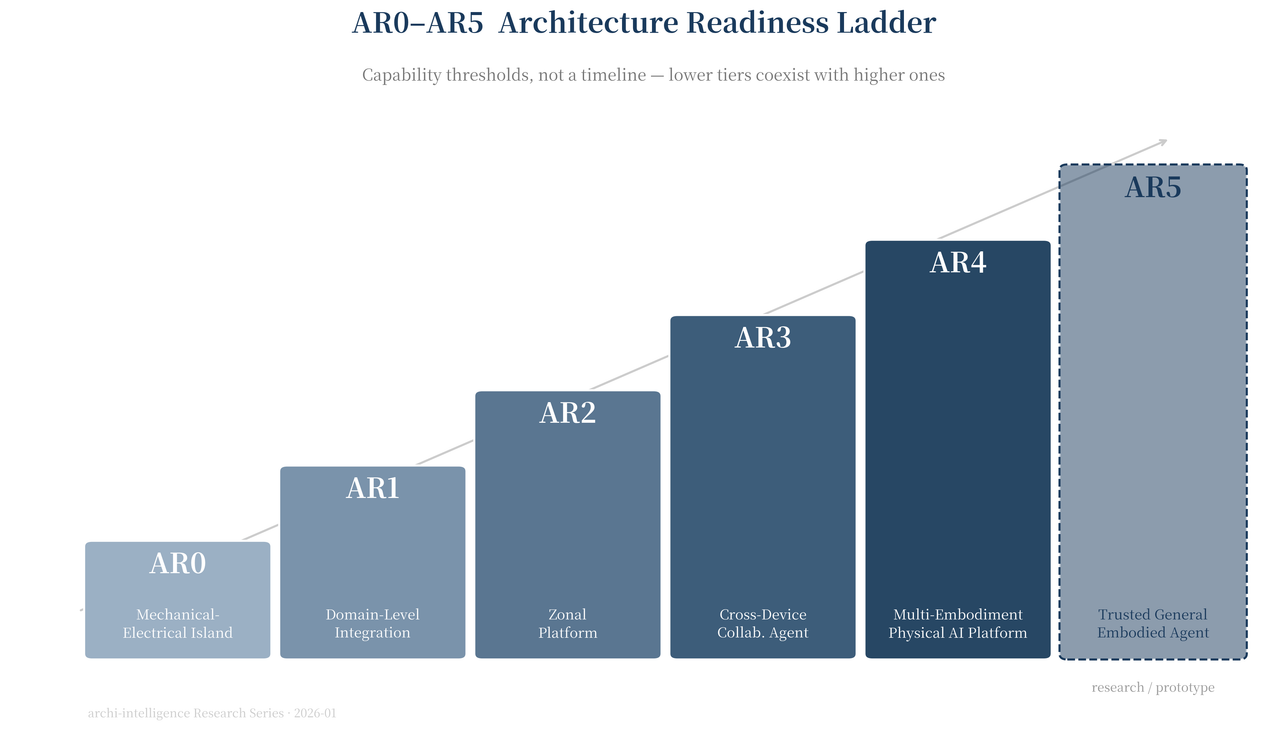
AR0–AR5 Architecture Readiness
Six capability thresholds a system's architecture crosses — from a mechanical-electrical island (AR0) to a trusted general embodied agent (AR5). Thresholds, not a timeline: lower tiers coexist with higher ones.
Working Paper 2026-01
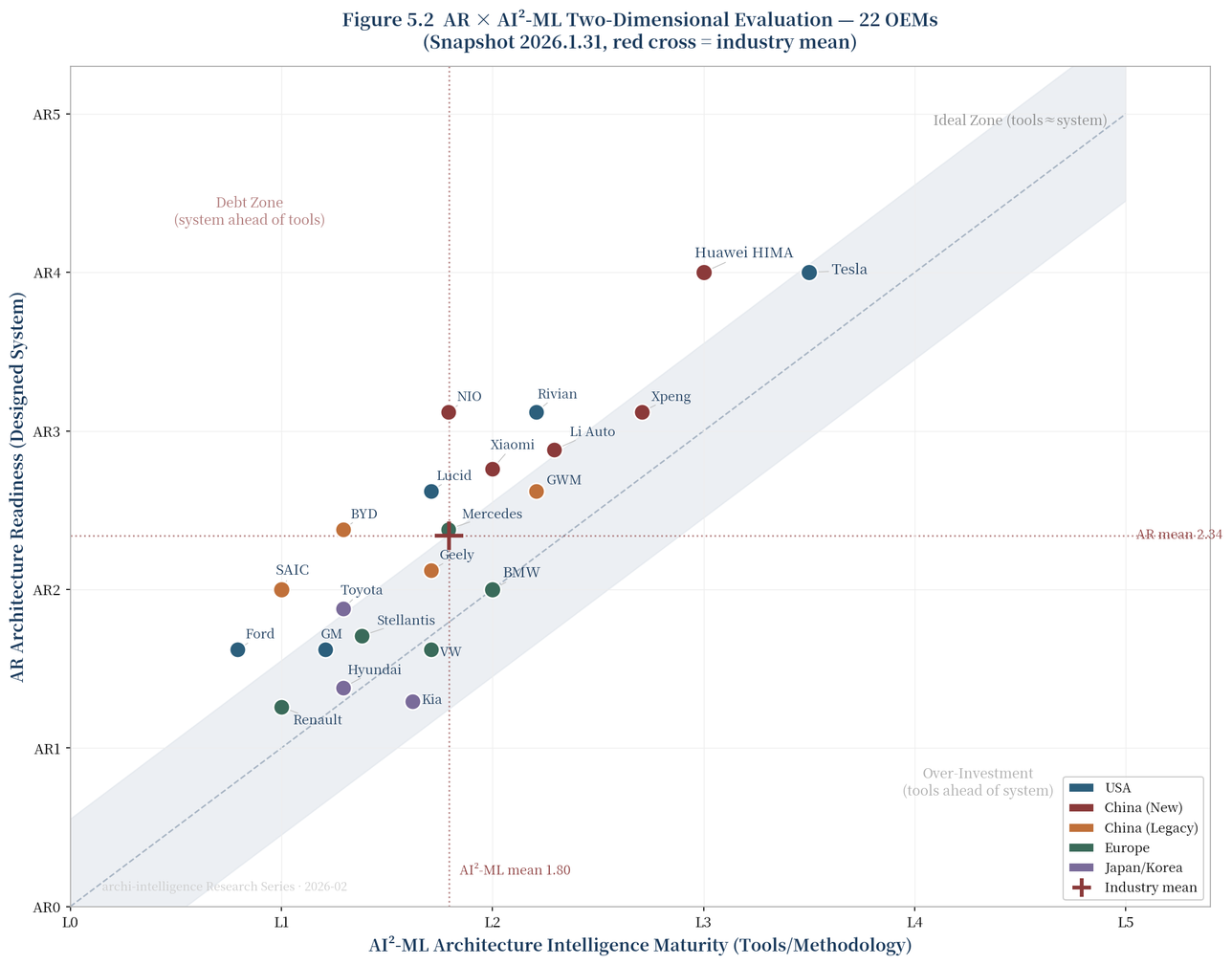
AR × AI²-ML Evaluation Map
A system’s architecture readiness (AR, vertical) against the maturity of the tools that reason about it (AI²-ML, horizontal). The diagonal band is the ideal zone where tools keep pace with systems; points above it sit in the debt zone — the system runs ahead of the tools that can verify it.
Working Paper 2026-01 · Snapshot 2026.01.31
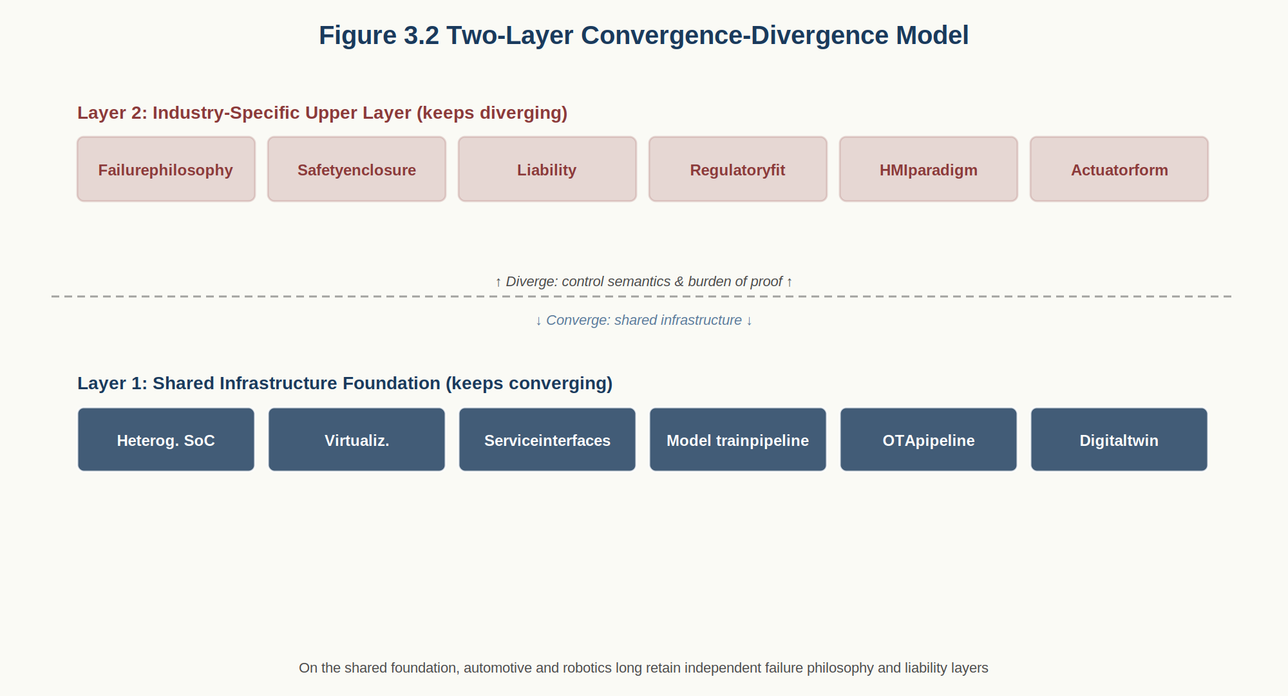
Two-Layer Convergence–Divergence
Why architectures across industries converge and diverge at once. Layer 1 (shared infrastructure — SoC, virtualisation, OTA, digital twin) keeps converging; Layer 2 (control semantics and the burden of proof — failure philosophy, liability, safety) keeps diverging. The dividing line is where verification obligation lives.
Working Paper 2026-01
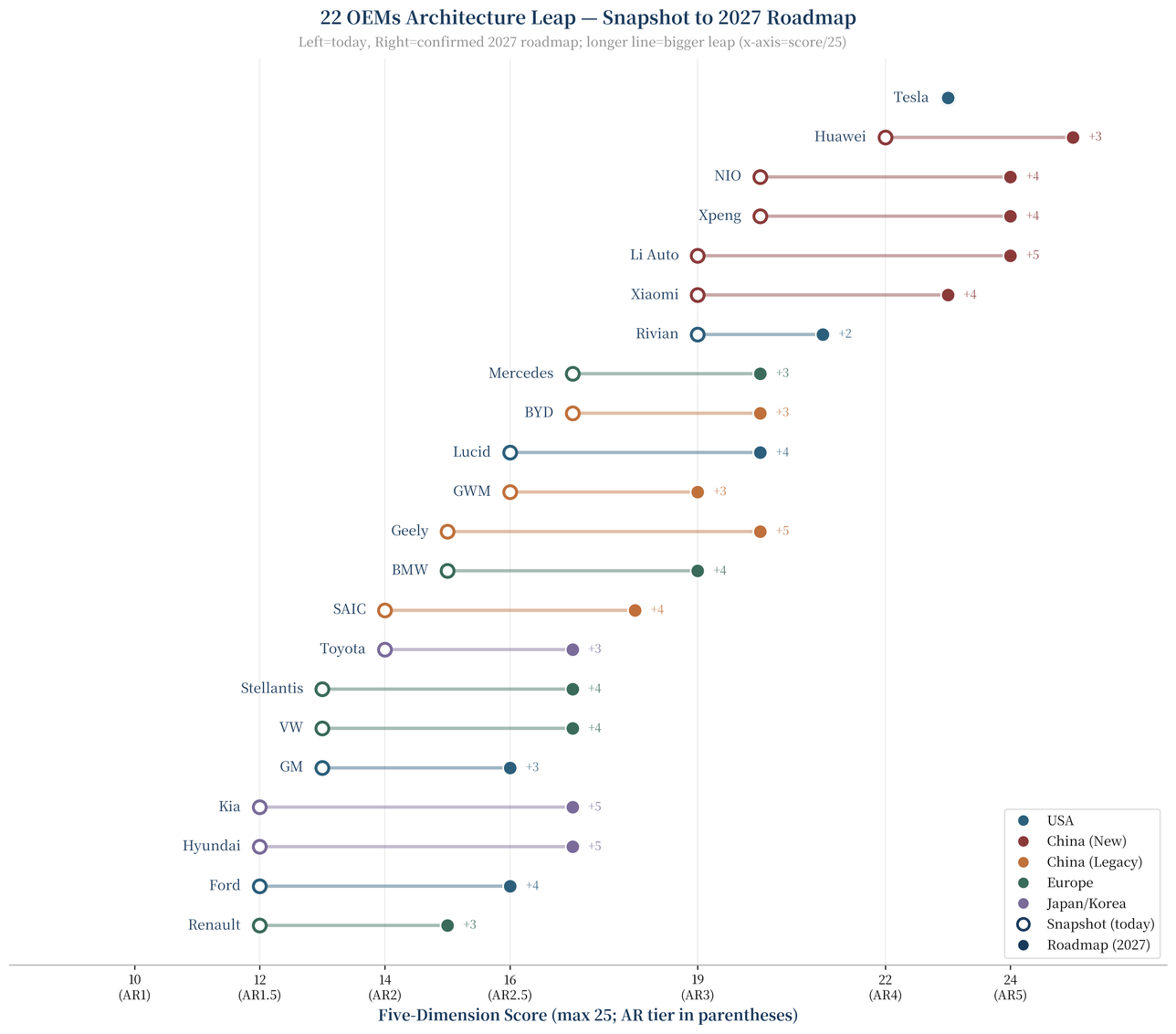
Architecture Leap — Snapshot to 2027 Roadmap
Each of 22 OEMs plotted from where it stands today (open circle) to its confirmed 2027 roadmap (filled), on the five-dimension score. A longer line is a bigger declared leap. Complements the interactive Index — this is the full-field view of who is moving, and how far.
Working Paper 2026-02
Read the paper → DOI 10.5281/zenodo.20513865 See also: The Index →
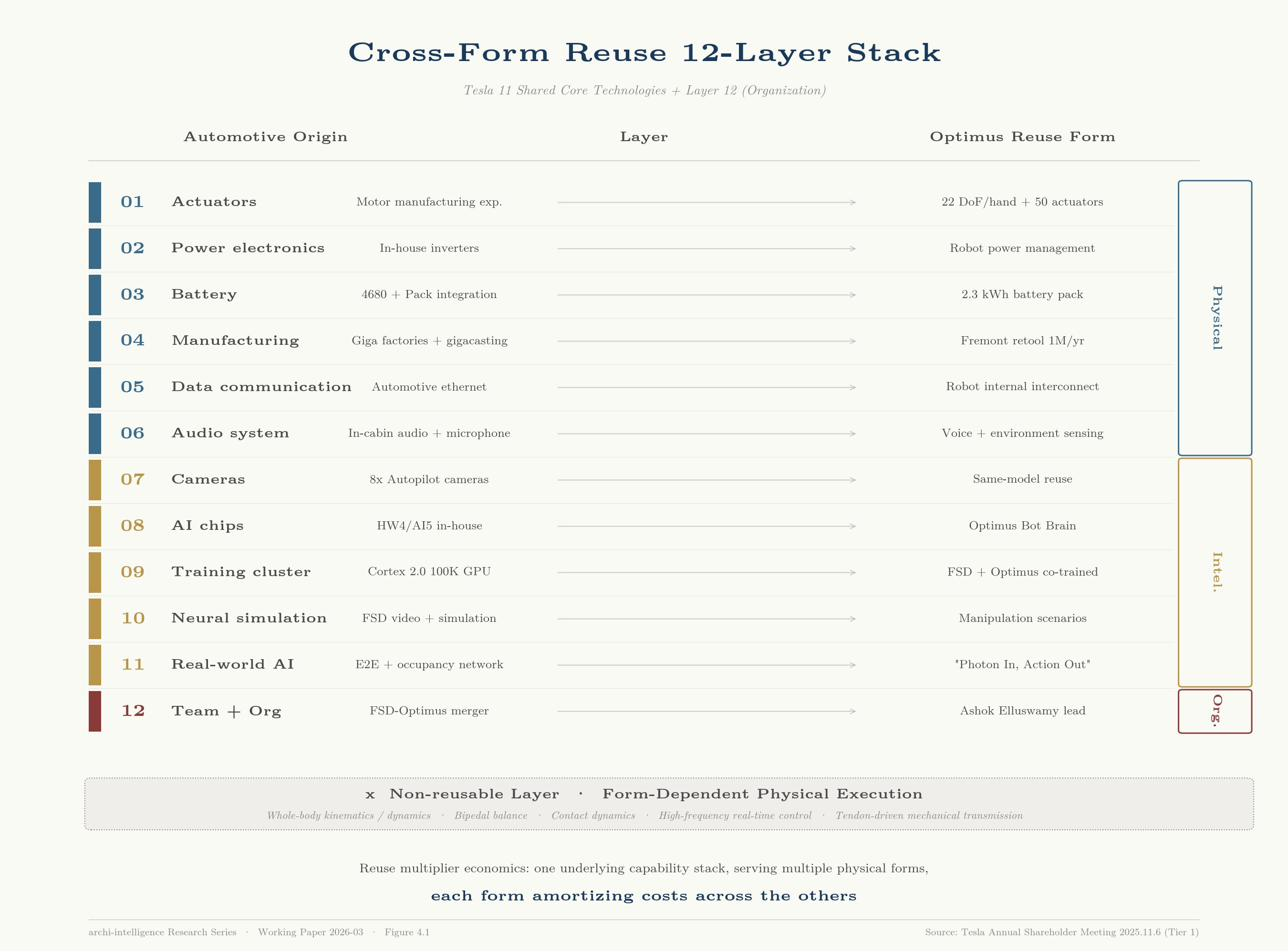
Cross-Form Reuse 12-Layer Stack
How capability accumulated in one physical form transfers to another. Tesla's eleven officially disclosed shared layers, grouped into physical (6) and intelligence (5), plus an implicit organizational twelfth layer. The boundary of reuse: accumulated capability transfers; morphology-dependent high-frequency motion control does not.
Working Paper 2026-03
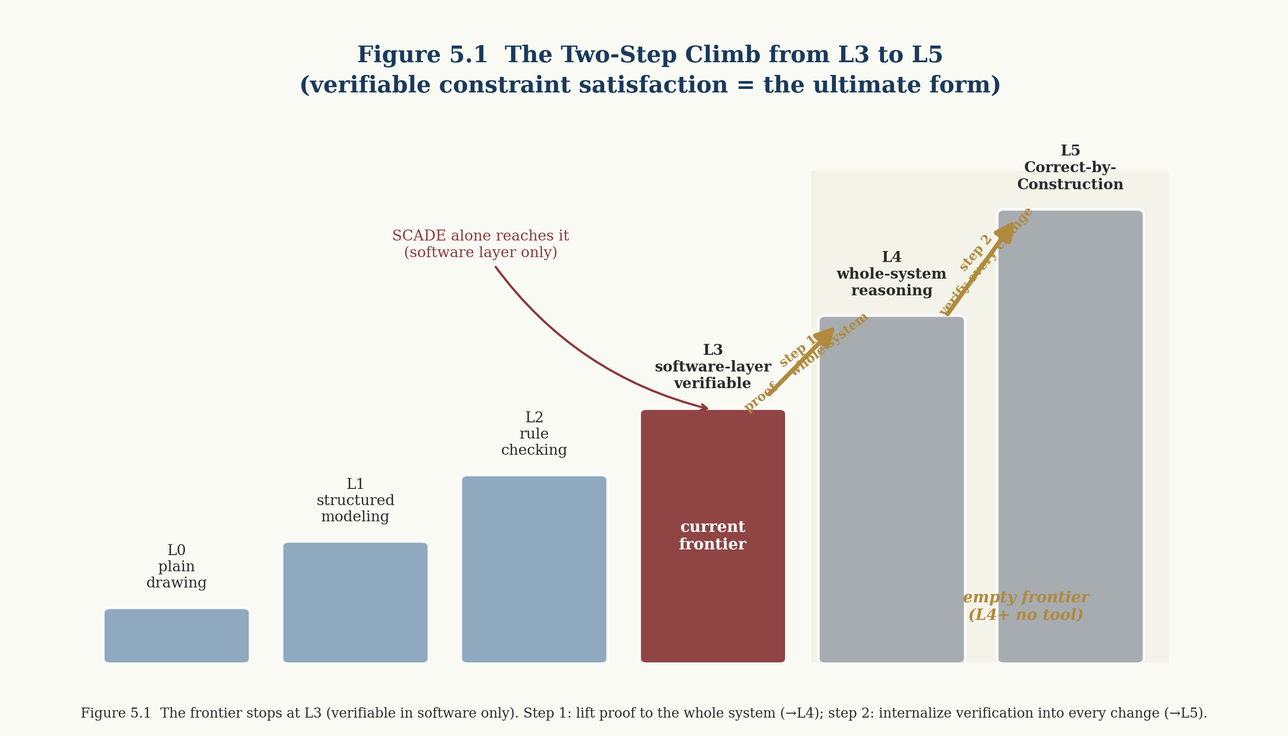
AI²-ML — The Empty Frontier
The maturity ceiling of architecture-design tools. The frontier stops at L3 (verifiable in software only, reached by SCADE alone); L4 (whole-system proof) and L5 (no unverified change) stand empty. Two steps remain: lift proof to the whole system, then internalise verification into every change.
Working Paper 2026-04 · Evaluation window 2024.01–2026.01